
Visit Xinjiang in Summer: A Practical Planning Guide
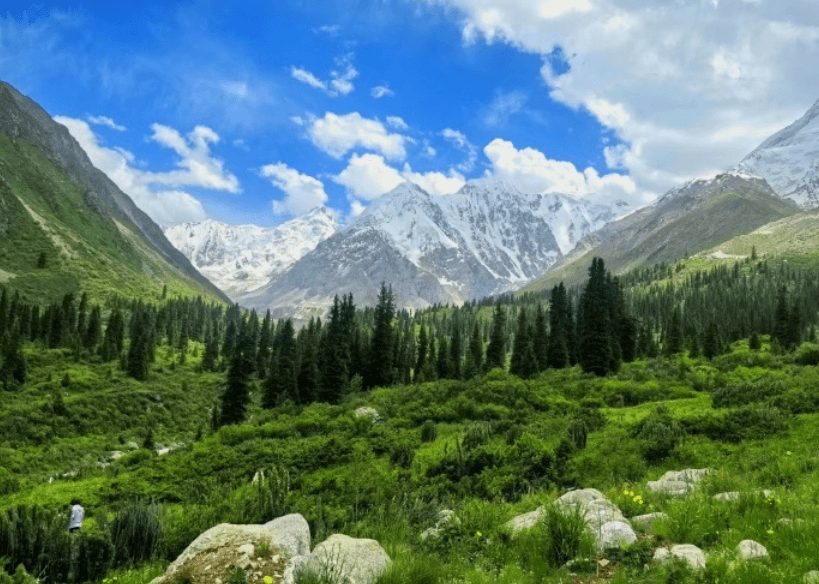
Xinjiang covers about one-sixth of China’s land area, and summer is the one stretch of the year when its highest passes, greenest grasslands and coolest alpine lakes are all reachable at the same time. To visit Xinjiang in June, July or August without exhausting yourself, plan around three fixed facts: the north and south sit more than 1,000 km apart, the official clock runs roughly two hours ahead of the sun, and the region’s most spectacular road is closed for about eight months a year.
This is a planning guide, not a pin list. It covers when to go, which region to anchor on, what each travel style actually demands, and exactly which details to re-verify before you spend money.
If you are building a first trip from scratch, our guide to planning a trip to China covers visas, payments and transport at national level, and combining Xinjiang with a wider China route explains how to sequence it with other destinations. Those are optional reads, not a substitute for checking your own dates.
Quick answer: what summer in Xinjiang is really like
| Question | Short answer |
|---|---|
| Best months | Mid-June to mid-September. Late June for wildflowers, July–August for the full range of routes, early September for the best light and lightest crowds |
| Ideal trip length | 8–10 days minimum for one region done well. A 5-day trip only works if you stay in the north |
| Biggest planning mistake | Trying to combine Kanas, Yili and Kashgar in one week |
| Hardest logistical item | The Duku Highway — short season, vehicle size limits, night closure, and rules that changed mid-season in 2026 |
| Easiest region for first-timers | North Xinjiang (Urumqi–Burgin–Yili loop) |
| Most rewarding for repeat visitors | South Xinjiang (Kashgar, Pamir, Taklamakan edge) |
| Currency and payments | Alipay and WeChat Pay accept international cards in cities; carry cash for remote petrol stations and small guesthouses |
| Carry every day | Original passport or ID card — checked at scenic-area gates, highway checkpoints and petrol stations |
When to visit Xinjiang: a month-by-month view of summer
Xinjiang’s summer is not one season. Altitude decides the temperature, and the difference between a Turpan afternoon and a Kanas morning is larger than most travellers expect.
| Period | Weather and conditions | Crowds | Best for | Watch out for |
|---|---|---|---|---|
| Early–mid June | Grasslands at their greenest; Sayram Lake’s lakeside flowers peak; passes opening | Moderate | Wildflower photography, Yili, Kalajun | Some high passes still closed; cold nights above 2,000 m |
| Late June–August | Peak summer. Grasslands lush, lakes at their bluest, fruit season beginning | Heavy, especially during school holidays | First-time trips, families, Kanas, Yili, Duku Highway | Heat in Turpan and the Tarim Basin (40 °C+, with local warnings reaching 45 °C); peak-season reservation pressure |
| Early–mid September | Clear light, golden grasslands, snow returning to the high passes | Light — roughly a third to half of peak | Photography, driving routes, unhurried pacing | Shorter daylight; some services winding down |
Two summer-specific details are worth building into the plan. First, the fruit calendar: Hami melons, grapes and figs ripen from July into September, and a market visit in Turpan or Kashgar in August is a genuine highlight rather than filler. Second, the clock: Xinjiang officially runs on Beijing Time, but solar time is about two hours behind. Shops commonly open around 10:00 and dinner rarely starts before 20:00, which means long summer daylight is a real advantage — you can drive until 21:00 and still arrive in daylight.
What to prioritise when you visit Xinjiang
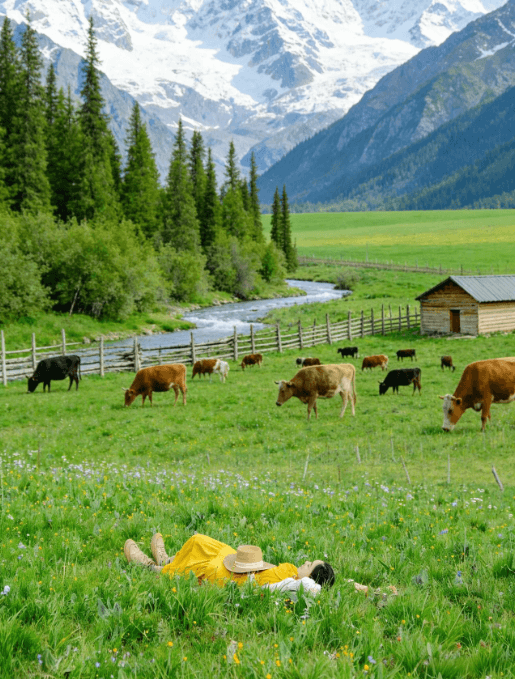
The strongest itineraries connect one region’s character to a daily rhythm you can actually sustain. Xinjiang is not short of highlights; it is short of short distances. Rather than moving continuously between distant places, choose one anchor experience per day and build outward from it.
| Priority | What it means in practice | Where it works best |
|---|---|---|
| Landscape | Alpine lakes, glacier-fed rivers, red-bed canyons, desert dunes and grassland in a single route | North Xinjiang: Kanas, Sayram Lake, Kalajun, the Duku Highway |
| Silk Road heritage | Oasis towns, excavated cities, cave temples and bazaars that trace the trade routes | Turpan (Jiaohe, Gaochang, Karez wells), Kuqa, Kashgar |
| Food | Lamb and cumin, hand-pulled noodles, pilaf, naan baked in clay ovens, and summer fruit that rarely travels | Kashgar night markets, Urumqi’s Erdaoqiao bazaar, Turpan’s grape valley |
| Living culture | Craft workshops, instrument makers, teahouses, and village life in Tuva and Kazakh communities | Kashgar old town, Hemu Village, Yining’s Kazanqi district |
| Family and soft adventure | Short walks, boat and cable-car options, horseback riding on grassland, low-altitude days | Sayram Lake, Nalati, Tianchi, Kumtag Desert near Shanshan |
UNESCO’s description of Xinjiang Tianshan explains why this region rewards slower travel. The inscribed property is a serial site of four components — Tomur, Kalajun-Kuerdening, Bayinbuluke and Bogda — spanning 606,833 hectares along 1,760 km of the Tianshan range. It protects glacier-capped peaks, undisturbed forests and meadows, clear rivers and lakes, red-bed canyons, and the contrast where those mountains meet the Central Asian deserts. Kalajun and Bayinbuluke alone justify two unhurried days rather than a drive-through. [1]
A useful rule for sequencing: give every overland day a hard ceiling of four to five hours of driving, and treat anything longer as a travel day with no sightseeing attached.
North, central or south? Choose one region first
Most disappointing Xinjiang itineraries fail at this step. The three regions have different distances, altitudes and best months, and they do not combine well inside a single week.
| Region | Main bases | Signature experiences | Days | Best months |
|---|---|---|---|---|
| North (Altay) | Urumqi, Burgin, Hemu, Fuhai | Kanas Lake and Guanyutai viewpoint, Hemu village, Five-Coloured Beach, Urho Ghost City | 5–7 | Late June–Sept; early Oct for autumn colour |
| Central (Tianshan & Turpan) | Urumqi, Turpan, Shanshan | Tianchi, Jiaohe and Gaochang ruins, Karez irrigation, Flaming Mountains, Kumtag Desert | 3–4 | April–May and September (summer is very hot) |
| West (Yili) | Yining, Nalati, Tekes, Sayram Lake | Kalajun and Nalati grasslands, Sayram Lake at dawn, Guozigou bridge, lavender farms in June | 4–6 | June–early September |
| South (Kashgar & Pamir) | Kashgar, Tashkurgan | Kashgar old town and Id Kah Mosque, century-old teahouse, Karakul Lake, Muztagh Ata views | 5–7 | June–September |
If your trip is shorter than ten days, pick one region and go deep. If you have twelve days or more, the natural pairing is north plus west — they share the Duku Highway corridor and the Yili Valley — which is far more efficient than bolting on Kashgar.
Choose a travel style that fits your time
| Travel style | How to structure it | Best for |
|---|---|---|
| Short visit (3–4 days) | One base, one anchor experience per day, no long transfers. Consider Tianchi plus Urumqi’s museum and bazaar | First-time travellers with limited time |
| Balanced trip (5–8 days) | One region, one major sight plus one slower experience each day, a single internal flight or rail leg | Most independent travellers |
| Deeper stay (9–14 days) | Two regions, travel days explicitly budgeted, a rest day every fourth day, flexibility for weather | Travellers who prefer a slower pace |
Private tour, small group or independent travel
| Factor | Independent | Small group | Private tour |
|---|---|---|---|
| Route flexibility | Highest, if you self-drive | Fixed departure route | High, adjustable day to day |
| Driving burden | You | None | None |
| Language support | Limited outside Urumqi and Kashgar | Guide throughout | Guide throughout |
| Duku Highway logistics | You arrange reservation and vehicle type | Handled by the operator | Handled by the operator |
| Best for | Confident drivers, repeat visitors | Solo travellers and couples wanting company | Families, mixed-ability groups, tight schedules |
The deciding factor is rarely price. It is how much of the region’s distance you are willing to manage yourself, and how much a fixed route would cost you in flexibility.
What to know before you book international travel
Xinjiang is a domestic destination for Chinese travellers, which means English-language coverage of entry rules is often out of date. Two policies matter most.
- Unilateral visa-free entry (up to 30 days) currently applies to ordinary passport holders from around 48 countries and is valid at all open ports nationwide, which includes Xinjiang’s airports. The current policy runs to 31 December 2026, with Russia extended to 31 December 2027. [2]
- 240-hour visa-free transit is a different scheme with a different condition: it restricts travel to designated ports and permitted stay areas. Xinjiang is not among the designated stay areas, so a flight routed as transit through Urumqi does not carry transit-visa-free privileges. If your itinerary depends on this policy, confirm the current permitted areas with the National Immigration Administration before booking. [3]
Either way, the practical sequence is: confirm your entry route, then book flights, then book anything that sells out seasonally (Kanas accommodation, and a Duku Highway slot in a peak year).
Build a reliable day-by-day plan
Start with fixed constraints: arrival time, departure time, hotel location, walking tolerance, and whether you need child-friendly or mobility-conscious pacing. Then identify anything with limited availability or an official reservation requirement, and schedule those first.
A day that works looks like this: a major landscape or sight in the morning while light and energy are best; lunch in a district you actually want to wander; one quieter stop in the heat of the afternoon; and a buffer of at least 90 minutes before any pre-booked dinner, train or flight.
Three summer itineraries you can keep
5 days — Northern lakes, one region only
- Day 1: Arrive Urumqi; Erdaoqiao bazaar in the evening
- Day 2: Fly or drive to Burgin; Five-Coloured Beach at sunset
- Day 3: Kanas Lake, Guanyutai viewpoint, the three bays
- Day 4: Hemu Village at dawn; return toward Burgin
- Day 5: Urho Ghost City en route to Urumqi; depart
8 days — North plus Yili, with the Duku Highway
- Day 1: Arrive Urumqi; acclimatise
- Day 2: Burgin; Five-Coloured Beach
- Day 3: Kanas and Guanyutai
- Day 4: Hemu Village; overnight in Burgin
- Day 5: Transfer south via Urho Ghost City; overnight in Dushanzi or Kuitun
- Day 6: Duku Highway north section; overnight Nalati
- Day 7: Nalati or Kalajun grassland; drive to Sayram Lake
- Day 8: Sayram Lake at dawn; return to Urumqi or fly out of Yining
12 days — Add South Xinjiang for Silk Road depth
- Days 1–8: as above
- Day 9: Fly Urumqi to Kashgar; old town and Id Kah Mosque at golden hour
- Day 10: Kashgar day — teahouse, Uyghur craft workshops, Grand Bazaar
- Day 11: Karakul Lake and Muztagh Ata via the Pamir highway (border-area permit required)
- Day 12: Kashgar departure
Duku Highway: the rules that change every year
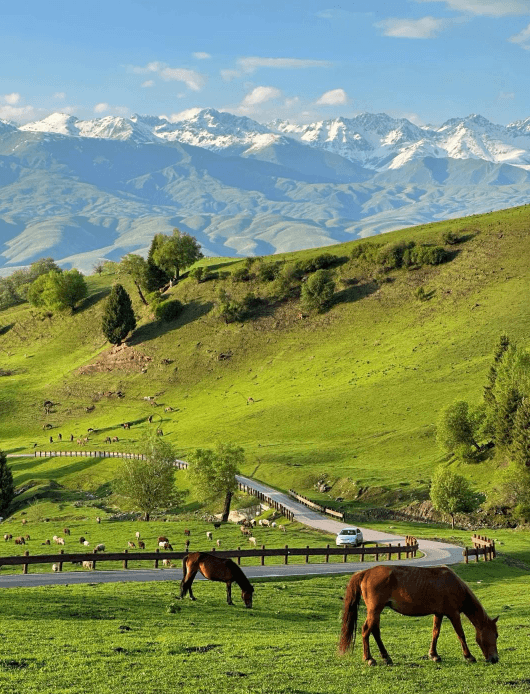
The G217 Duku Highway is the single most planning-sensitive element of a Xinjiang summer. It runs 561 km from Dushanzi in the north to Kuqa in the south, crossing several alpine passes — including the Hashilegen Pass at roughly 3,390 m — and it condenses desert, canyon, grassland, glacier and lake into one road.
What you need to know for 2026:
- Season: it reopened on 1 June 2026 and was expected to close in mid-October with the first heavy snow. The road is open for roughly four months a year.
- Daily hours: generally 08:00–19:00, with some southern sections flexing to 21:00. Night driving is prohibited, and the northern entry closes to new traffic at 19:00.
- Vehicle limits: only small passenger vehicles with 7 seats or fewer (as shown on the registration document) and goods vehicles up to 5 tonnes. Eight-seat vans, buses and towed caravans are refused at the checkpoint, regardless of how many people are actually on board.
- Reservations: the northern section between Wusu Yi and the Nalati entrance (about 185 km) used a free, online, 1–7-day-advance reservation system from 25 June 2026, capping traffic at 3,000 vehicles a day. That requirement was lifted from 1 September 2026. The system has already changed mid-season once, so check the current status before you travel.
- Fuel and pace: there are five petrol stations along the route. Fill up at the entrance, allow one to two days for the full crossing, and expect speed limits of 40–60 km/h, dropping to 30 km/h on the passes.
- Best window: early to mid-September. Traffic drops to roughly 40% of peak, the light is excellent, and the weather is drier.
You can check live conditions through the official Xinjiang tourism platform (Visit Xinjiang / 游新疆) and the regional culture and tourism bureau’s public service pages. [4]
Transport, tickets and practical checks
Transport should support the experience, not dictate it. Compare the time from your lodging to the first stop, the likely return journey after dark, and the walking or transfers between points.
- Flights are the only realistic way to cover Urumqi–Kashgar (about 2 hours) or to reach Kanas and Burgin without losing two days.
- Rail works well for Urumqi–Turpan and Urumqi–Hami. High-speed services make a Turpan day trip genuinely viable.
- Driver-hire is standard for inter-city scenic routes. A seven-seat vehicle is the practical upper limit if your route includes the Duku Highway.
- ID checks are routine. Carry your original passport or ID card daily — scenic-area gates, highway checkpoints and petrol stations all require it.
- Tickets and reservations. Kanas charges around ¥230 for a one-day entry ticket with one shuttle round trip; Nalati and Kalajun bundle entry with a required internal shuttle in the ¥120–135 range. Treat every price as indicative and confirm on the official channel, because seasonal promotions and winter/spring half-price periods make published prices unreliable.
- Mobile coverage is good in towns and patchy in mountain valleys. Download offline maps and keep a screenshot of your bookings and hotel addresses in Chinese.
- Altitude and heat are both real. Tianchi sits at about 1,980 m; the Duku Highway passes above 3,000 m. Meanwhile Turpan and the Tarim Basin regularly exceed 40 °C in July and August. Pack layered clothing, sun protection and strong DEET-based insect repellent for the grasslands.
- Border-area permits. Tashkurgan and the Pamir lakes require a permit arranged in advance in Kashgar.
What summer in Xinjiang costs
Indicative per-person, per-day figures for two people sharing. Domestic airfares inside Xinjiang are the single largest variable.
| Style | Accommodation | Transport | Food | Typical daily total |
|---|---|---|---|---|
| Budget | Guesthouses and simple hotels | Public transport and shared shuttles | Market and noodle-shop meals | ¥350–550 |
| Mid-range | 3–4 star hotels, scenic-area lodges | Private driver between cities | Restaurant meals plus a market evening | ¥800–1,300 |
| Comfort | Best available in each location | Private driver plus internal flights | Guided dining and special experiences | ¥1,800+ |
Summer is peak season in Xinjiang: Kanas lodges and Hemu guesthouses can double or triple their low-season rates, and flights to Burgin and Kashgar sell out during the school holidays. Booking those two items early saves more than any other decision.
How to make the experience more meaningful
Context improves almost every visit. Read a little about the landscape, the community, the architectural tradition, the conservation framework or the historic period before you arrive, then leave space to observe rather than racing through a script. A short primer on the Karez underground irrigation system will change how Turpan looks; knowing that Kalajun’s meadows sit inside a UNESCO property changes how Nalati feels.
A few habits make the day better for everyone:
- Stay on signed routes inside protected areas; off-track trampling damages grassland that takes years to recover.
- Keep noise low in religious and memorial spaces, and dress modestly at active religious sites.
- Ask before photographing people, especially in village settings, and accept a no.
- Buy directly from village workshops and family-run stalls where you can; it keeps craft traditions economically viable.
- Carry a refillable bottle and a rubbish bag. Water refilling is common in hotels; waste collection is thin on long drives.
Mistakes that ruin a summer Xinjiang trip
- Too many regions, too few days. Every extra region adds a flight and a lost half-day.
- Ignoring the clock. Restaurants, shops and some transport run on solar time. Planning dinner at 18:30 will leave you alone in an empty restaurant.
- Assuming a past Duku Highway rule still applies. Between 2026 and a 2019-era guide, the reservation system, the vehicle limit and the closing date have all changed.
- Booking an eight-seat vehicle for a Duku Highway route. It will be turned away at the checkpoint.
- Treating Turpan as a summer highlight. It is extraordinary, but July and August afternoons are punishing. Go early, or save it for a shoulder season.
- Leaving without physical ID. A photocopy will not get you through a checkpoint.
- No buffer before a pre-booked flight. Mountain weather and checkpoint queues are the two most common causes of missed connections.
Frequently asked questions about visiting Xinjiang
How much time should I allow for a Xinjiang trip?
Allow 5 days minimum for one region done properly, 8 days to combine North Xinjiang with Yili, and 12 days or more if you want to add Kashgar and the Pamir. A three-day trip is only realistic if you stay within reach of Urumqi.
When is the best time to visit Xinjiang?
Mid-June to mid-September. Late June suits wildflowers and the Yili grasslands, July and August give you the widest route availability, and early September offers the best combination of light, clear roads and manageable crowds.
Do I need to book tickets and transport in advance?
Book ahead for anything with a timed reservation, for inflexible dates, and for seasonal accommodation in Kanas, Hemu and Burgin. Do not assume that a rule from an older guide is still current — the Duku Highway reservation system was introduced and withdrawn within a single 2026 season.
Can I visit Xinjiang on visa-free transit?
Not through the 240-hour transit scheme, which restricts travel to designated ports and stay areas that do not include Xinjiang. Citizens of the roughly 48 countries covered by China’s unilateral visa-free policy can enter through Xinjiang’s airports for up to 30 days. Verify your specific nationality and route with the National Immigration Administration before booking.
Is Xinjiang suitable for first-time visitors to China?
Yes, provided the itinerary matches your pace and you leave room for logistics. Start with clearly defined priorities, keep the first day simple, and rely on verified transport and reservation information rather than trying to cover too much.
Should I travel independently or join a tour?
Choose the option that gives you the clearest route, realistic timing and the support level you need. Independent travel rewards confident drivers; a small group removes the driving and language burden; a private tour is usually the most efficient choice for families and mixed-ability groups.
What should I pack for summer in Xinjiang?
Layers rather than one heavy jacket — a summer day can end near freezing at altitude. Sun protection, a strong DEET-based repellent, a windproof shell, and printed or offline copies of your bookings and ID.
Is the Duku Highway open in summer 2026?
It reopened on 1 June 2026 and was expected to close in mid-October. It is open daily in daylight hours only, restricted to vehicles with seven seats or fewer, and its peak-season reservation requirement was lifted on 1 September 2026. Confirm the current status before travelling.
References
- UNESCO World Heritage Centre — Xinjiang Tianshan (inscribed 2013, criteria vii and ix; four components: Tomur, Kalajun-Kuerdening, Bayinbuluke, Bogda). https://whc.unesco.org/en/list/1414/
- China Visa Application Service Center — Summary of partial visa policies, unilateral visa-free list valid to 31 December 2026. https://bio.visaforchina.cn/IST4_ZH/tongzhigonggao/551665978287722508.html
- National Immigration Administration — Transit visa-free policies, 240-hour scheme, 57 countries and designated ports and stay areas. https://www.nia.gov.cn/n794014/n1050181/n1050484/c1731205/content.html
- Xinjiang Uygur Autonomous Region Culture and Tourism Department — official tourism public service information and the Visit Xinjiang (游新疆) one-stop platform. https://wlt.xinjiang.gov.cn/wlt/c112780/newwenlvtin_index.shtml · https://www.xinjiang.gov.cn/xinjiang/dmxj/dmxj.shtml
- Sina Travel — Duku Highway 2026 opening dates and traffic rules (season, daily hours, vehicle limits, reservation system). https://travel.sina.cn/2026-09-10/detail-inirhrrh3227815.d.html
All URLs accessed 14 September 2026. Prices, opening hours and traffic rules in this guide are indicative and change frequently; confirm each item on the official channel before you commit to a booking.
About this guide
Written by the [Publication Name] travel desk, which plans and tests China itineraries for independent travellers. Route timings are based on operator schedules, official road and traffic notices, and seasonal first-hand trip planning. This guide contains no sponsored placements. Corrections and updates: [editorial contact].
Disclosure: we do not sell Xinjiang tours directly; recommendations are based on route practicality, published operator terms and verified logistics.


